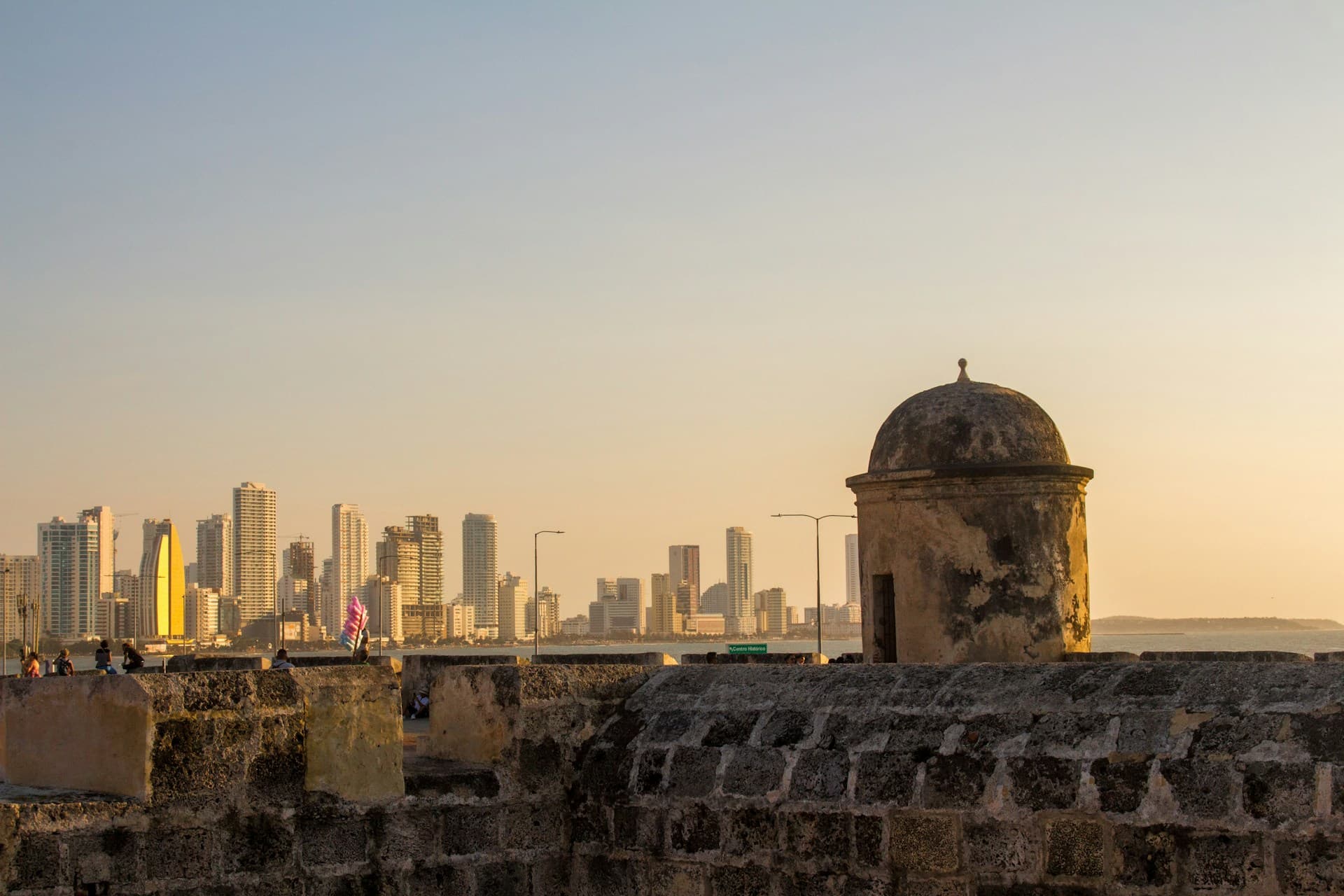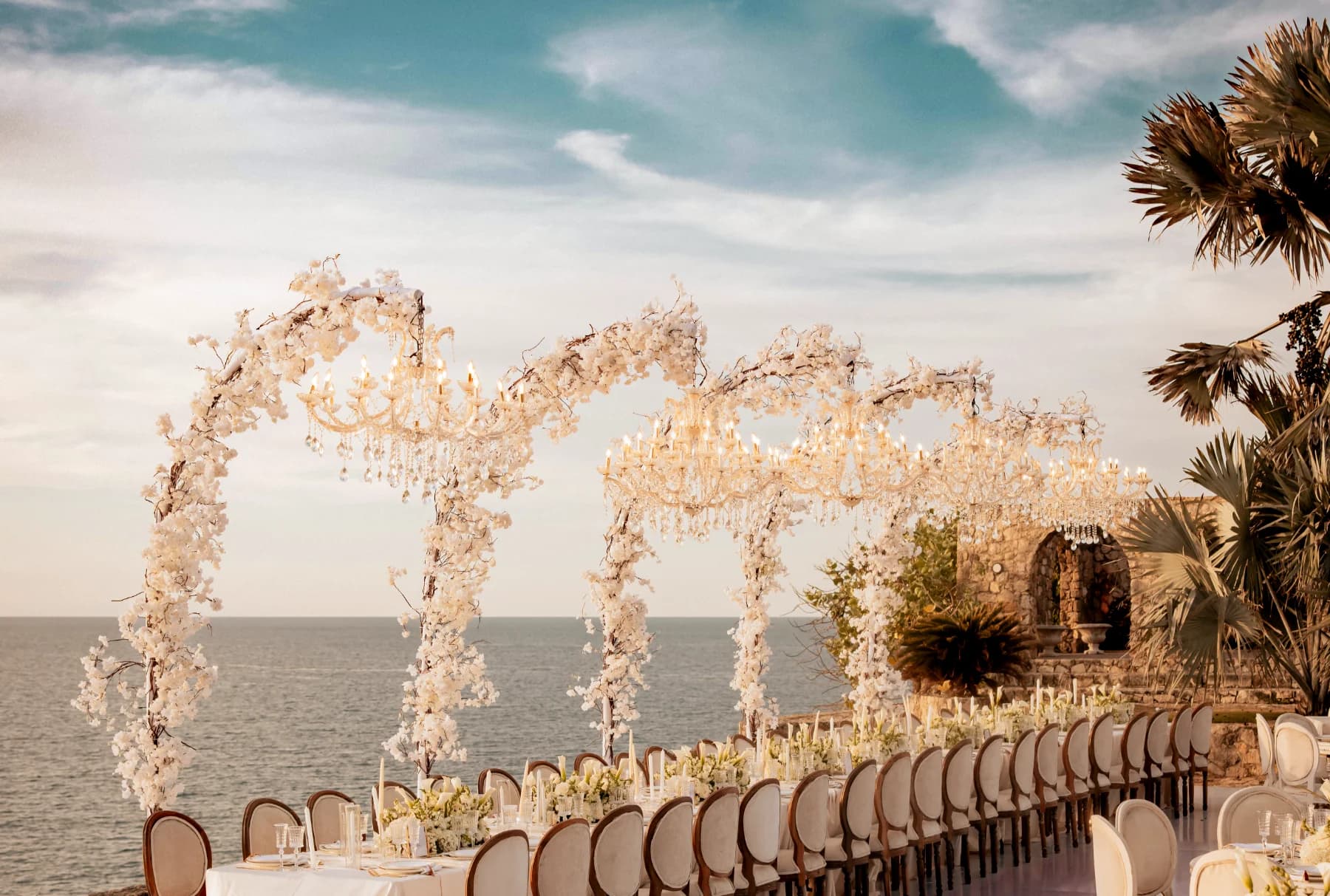
The haciendas of Colombia's Caribbean Coast are, for us, the ideal venue for large weddings. Not because they're the most elegant or the most photogenic — though many are — but because they're where the kitchen has room to truly unfold. Gardens that allow you to set up three live stations without them competing for space. Service areas where a full field kitchen fits comfortably. No time restrictions that let the timeline breathe. And the scale to serve 150, 200, 400 guests without compressing anything.
After years of producing weddings at haciendas between Cartagena and Barranquilla, we have a menu design system specific to this format. It's not the same as cooking for a hotel ballroom or a colonial house. The hacienda demands a different logic: more generous, more rustic without losing refinement, and centered on local product.
The space advantage: satellite kitchens
At a typical Caribbean Coast hacienda, we have between 5,000 and 20,000 square feet of usable outdoor area. That means we can set up multiple satellite kitchens — each dedicated to a type of preparation — distributed strategically throughout the garden.
A typical satellite kitchen has: a portable industrial griddle, steel work table, mobile refrigeration, gas tank, fire extinguishers, and a washing station. Each one operates independently with its own team of cooks. This allows the seafood grill to be in one corner of the garden, the ceviche station by the pool, the creole roast near the trees, and the dessert table under a pergola.
The key is distribution. Guests don't line up at a single point: they move through the space, discover stations, try different things. The menu becomes a journey experience, not a rigid sequence of plates.
The live station format
At haciendas, live stations are the star. They're the format that best takes advantage of the space and generates the most visual and gastronomic impact. These are the stations we set up most:
Seafood grill: prawns, octopus, squid, and whole fish cooked on the grill in front of guests. Marinated with coconut butter, lime, and chili. Served on a clay plate with roasted yuca and tropical salad. It's the station that always has a line.
Ceviche bar: three or four different preparations assembled on the spot. Red snapper with mandarin lime and sweet chili. Shrimp with coconut and cilantro. Octopus with olive oil and cherry tomatoes. All over ice, with crispy tostones on the side.
Fresh pasta: a made-to-order pasta station works spectacularly at haciendas. Fettuccine with seafood in saffron sauce, or cheese ravioli with herb butter. The cook prepares each plate in front of the guest in 3 minutes.
Creole roast: pork or beef slow-cooked over coals, with rustic sides: yuca, sweet plantain, coconut rice, avocado salad. This format connects with Caribbean coastal tradition and works perfectly for weddings with many local guests.
The extended cocktail hour with hot hors d'oeuvres
At a hacienda wedding, the cocktail hour isn't a 30-minute formality while the couple takes photos. It's a one to one-and-a-half-hour experience where guests walk through the gardens with a drink in hand and hors d'oeuvres circulate nonstop.
Our favorite hacienda hors d'oeuvres: mini coastal cheese arepas with hogao and chicharron. Prawn skewers with tamarind glaze. Tostones with snapper ceviche. Yuca balls stuffed with cheese and chili. Fish croquettes with lemon aioli. All hot, all served on the spot, all in one bite.
The rule: 8 to 10 pieces per person during cocktail hour. Enough so nobody arrives at dinner desperately hungry, but not so much that it ruins the appetite for the stations.
The shared table: a format that's back
At large haciendas, we've returned to a format that had fallen out of use: the shared table with communal platters. Instead of individual plates, large serving dishes are placed in the center of the table with generous portions of each preparation. Guests serve themselves, pass the dishes, share.
It works especially well with Latin American families where food is a social act. The coconut rice arrives in a clay pot. The whole fish comes on a wooden board. The salads in large bowls with tongs. It's rustic, it's generous, and it generates an energy at the table that individual plating simply can't achieve.
The condition: the food has to be truly abundant. No half-empty platters. If you're going to put a platter of prawns in the center, let it be 30 prawns, not 12. Generosity is the essence of this format.
The tropical dessert table
At haciendas, the dessert table has to be a spectacle. We have space, we have shade (pergolas, trees), and we have the possibility of building something grand. Our approach: a 12- to 20-foot table with 8 to 12 different preparations, all based on tropical fruits and local flavors.
What we put on it: passion fruit mousse in individual glasses. Lemon tartlets with toasted meringue (yes, at haciendas this works because there's shade). Corozo and tamarind ice cream served on the spot from a vintage cart. Artisanal cocadas. Coconut brûlée. Guava panna cotta. Tres leches cake with seasonal fruits. Chocolate bites with passion fruit filling.
The dessert table is set up an hour before dessert and kept covered with cloches or fabric until the reveal moment. This protects from the heat and creates an impact moment when it's uncovered.
Transport logistics
Most haciendas are 30-60 minutes from Cartagena or Barranquilla by road. That means the entire operation travels by land: refrigerated trucks, equipment vans, staff vans. The cold chain is easier than on an island, but the volume is larger.
For a 200-person hacienda wedding, we move: one refrigerated truck with all food, one equipment truck (griddles, tables, mobile refrigeration, backup generators), one van with glassware and dinnerware, and two vans with kitchen and service staff (between 25 and 35 people).
We leave the central kitchen at 8 am for an event that starts at 5 pm. Complete setup takes between 4 and 5 hours. That includes assembling the satellite kitchens, setting up the stations, preparing the buffet tables, installing the washing stations, and completing the full mise en place.
Local product: the menu's star
A hacienda wedding on the Caribbean Coast has to taste like the Caribbean Coast. That means local product as the backbone of the menu: catch of the day brought from Bazurto market or directly from fishermen in La Boquilla. Yuca, yam, plantain from nearby farms. Fresh coastal cheese of the day. Seasonal tropical fruits: mango, passion fruit, corozo, sapodilla, tamarind. Fresh garden herbs: basil, wild cilantro, mountain oregano.
It's not just a gastronomic decision: it's a decision about coherence. When you're at a hacienda surrounded by palm trees and tropical gardens, the menu has to reflect that place. A filet mignon with imported truffle sauce feels out of context. A whole grilled snapper with yuca and avocado salad feels exactly where it should be.
Pairings: regional cocktails and wines
For the bar, we design drink menus based on local fruits: passion fruit cocktail with aged rum, tamarind margarita, gin with coconut water and lime, corozo mojito. They're fresh, tropical, and connect with the food.
For those who prefer wine, we recommend fresh whites and rosés that can handle the heat: Albariño, Verdejo, Sauvignon Blanc from cool climates. Heavy reds don't work at 90°F. If the couple insists on red, we suggest serving it slightly chilled (60-64°F) and choosing light grapes like Pinot Noir or Grenache.
The scale: 150 to 400+ guests
Haciendas are the only format in Cartagena where we can comfortably serve more than 200 guests with a high-quality menu. The key is multiplication: more stations, more satellite kitchens, more staff. It's not about making the same thing bigger, but about adding service points so the flow never stops.
For 200 guests: 3 live stations + dessert table. For 300: 4-5 stations + 2 dessert points. For 400+: 6 stations minimum, distributed in separate garden zones, with subtle signage to guide guests.
Staff scales proportionally: 1 station cook per 40-50 guests, 1 server per 15-20 guests, 1 bartender per 50 guests. At a 300-person wedding, that means a team of 40-45 people between kitchen, service, and bar.
The hacienda allows it because it has the space. And when the space, the menu, and the team are aligned, the result is a wedding where 300 people eat spectacularly well without anyone having felt a single line.