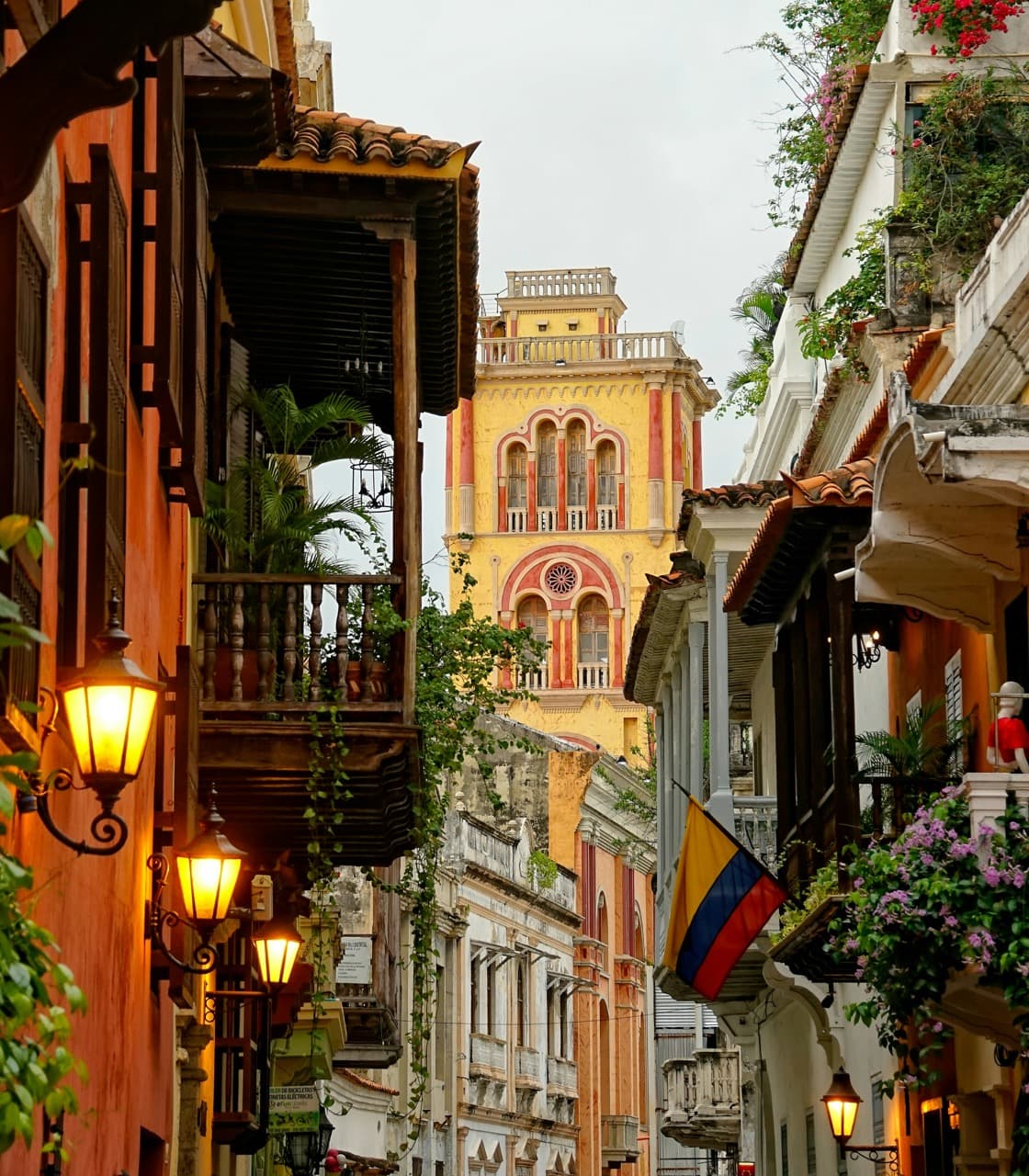
Every week someone writes to us with the same dream: they want to get married in a colonial house in the center of Cartagena. The mental image is irresistible — a courtyard draped in bougainvillea, whitewashed walls, candles, a long table under the stars. And yes, that exists. But what doesn't appear in the picture is the equipment truck that can't enter after 2 pm, the 40-square-foot kitchen, the stairs where 200 plates have to be carried up, and the neighbors who call the police if the volume exceeds a certain level after 11 pm.
This isn't meant to scare anyone. It's so you understand what catering in the historic center really involves, and why the experience of the team you hire makes the difference between a magical wedding and a logistical disaster.
Vehicle access has a closing time
In Cartagena's walled city, cargo vehicle access is restricted. Depending on the street and zone, trucks and large vans can only circulate until 2 or 3 pm. That means all kitchen equipment — ovens, griddles, portable refrigerators, glassware, dinnerware, linens, furniture, flowers, sound — has to be inside the house before that time.
What seems like a minor detail is actually the backbone of the entire operation. If something is forgotten, there's no way to bring it in later by large vehicle. You'd have to carry it by hand from outside the wall. We use a double-verified loading checklist and arrive no later than 10 am to build in margin.
Narrow corridors and unforgiving stairs
Colonial houses were not designed for catering operations. The hallways are 30 inches wide. The stairs are steep, uneven, and sometimes spiral. The doors are narrow. This directly impacts how much staff you can move, what equipment you can bring upstairs, and how you organize the flow of service.
For a typical 100-person wedding in the center, we calculate 1.5 times more service staff than at an open venue. Why? Because every trip takes longer. Carrying plates up a stone staircase is not the same as crossing a flat banquet hall. The risk of accidents goes up and the pace of service drops if you don't compensate with more hands.
The kitchen: the central problem
Many colonial houses in Cartagena simply don't have a working kitchen. Those that do usually have spaces of 30 to 50 square feet, with no industrial ventilation, no capacity to feed more than 80 people with a hot menu.
Our standard solution: set up a field kitchen in the service area. This means bringing portable industrial griddles, steel work tables, mobile refrigeration, gas tanks, and fire extinguishers. We build the kitchen like a production set: everything arrives packed, gets assembled on-site, and comes down that same night. The minimum space we need to operate well is about 80 square feet. If the house doesn't have it, we set up a service tent on the terrace or back patio.
Noise restrictions and the neighbors
The historic center is a residential zone. The houses share walls with families who live there permanently. That means there are real noise restrictions — not just legal, but about coexistence. Live or amplified music usually has to drop to conversational volume by 11 pm, and in some cases by 10 pm.
For catering, this matters because the service timeline is conditioned by it. If the music stops at 11, dinner has to end by 10:15 at the latest to leave room for dessert and the toast before the sound cuts off. That compresses everything backward: the cocktail hour must start on time, the hors d'oeuvres have to flow quickly, and dinner cannot fall behind.
The heat in enclosed courtyards
The interior courtyards of colonial houses are beautiful, but in Cartagena — with 80% humidity and temperatures of 90°F at night — they can turn into ovens. There's no outdoor air conditioning, and industrial fans compete with candles and decor.
This impacts the menu directly. Preparations with chocolate, butter, or whipped creams don't survive 45 minutes on an outdoor dessert table in the center. Cheeses melt. Emulsified sauces break. We design menus that withstand the heat: ceviches over ice, roasted vegetables that work at room temperature, desserts based on tropical fruits and sorbets served on the spot.
What menu works best in the historic center
After years operating in colonial houses, we know clearly what works and what doesn't. What works: plated menus in three or four courses, with contemporary Caribbean cuisine. Dishes that finish cold or can be completed in a field kitchen: local fish with pickles, grilled octopus with yam purée, prawns with coconut butter and citrus, farm-roasted vegetables, and desserts like corozo ice cream, passion fruit mousse in a glass, or fruit tartlets.
What doesn't work: live stations that require smoke extraction, frying that generates excessive smell in enclosed spaces, extensive dessert table setups that suffer in the heat, or menus with more than five courses that stretch the service beyond what the timeline allows.
Typical timeline for a wedding in the center
Here's what a day of operations looks like in the walled city:
10:00 am — Loading crew arrives. Unload equipment, furniture, glassware, field kitchen. Everything verified against checklist.
12:00 pm — Field kitchen setup. Installation of refrigeration, gas, work tables. Equipment testing.
2:00 pm — Vehicle access closes. From here on, anything missing comes in on foot.
3:00 pm — Room setup. Tables, linens, centerpieces, lighting, dinnerware.
5:00 pm — Service team arrives. Operations briefing, protocol review, menu walkthrough with each server.
6:00 pm — Cocktail hour begins. Hot and cold hors d'oeuvres circulating, bar operational.
7:30 pm — Call to table. First course served within 15 minutes max.
9:45 pm — Dessert and toast.
10:30 pm — Cake cutting, last drinks.
11:00 pm — Music lowers or stops. Silent breakdown begins.
1:00 am — Equipment loading (by hand if no nighttime vehicle access).
Why experience is non-negotiable
We don't say this for marketing: we say it because we've seen weddings in the center fall apart due to inexperienced teams. The vendor who didn't know the truck couldn't enter after 2. The chef who set up a fryer in an enclosed courtyard and filled the wedding with smoke. The service team that couldn't carry plates up steep stairs without spilling.
When catering works well in the historic center, it looks like magic. The guests only see the lit courtyard, the beautiful plates, the wine flowing. They don't see the three hours of setup, the kitchen assembled in a hallway, or the crew carrying glassware by hand through cobblestone streets at one in the morning. And that's exactly how it should be.